
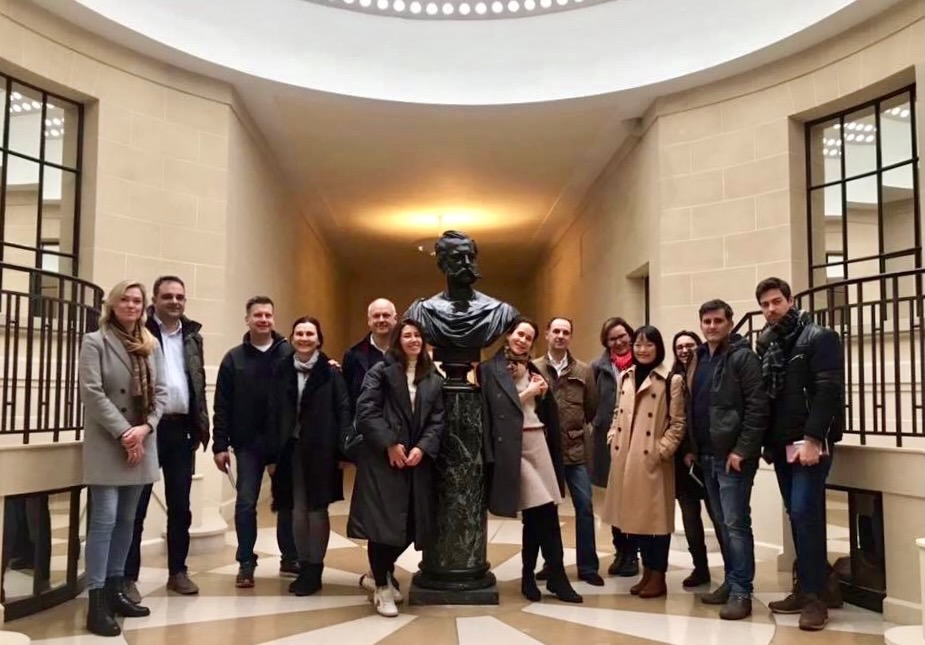
Weinakademikers on Champagne study trip
如果你鍾愛氣泡酒,你必定會愛上香檳。香檳產區於艾菲爾鐵塔以東不過一兩個鐘頭的車程,下回到巴黎,請記得氣泡微醺輕旅行近在咫尺喔!香檳區有著四季分明的寒帶大陸型氣候,產出的葡萄自帶淡淡青蘋果和柑橘類果香,特別襯托出酵母帶來的烤麵包、餅乾等優雅迷人香氣。此外,寒冷氣候與酵母陳年賦予香檳高抗氧化力,完美保存了特殊風土帶來的些許礦物味,更在白中白展現無遺。不斷上升的綿密氣泡有著輕快的節奏,像極了一曲華爾茲,無怪乎香檳被稱為為節慶而生的飲料!近年來,小農香檳不斷受到矚目,儘管大品牌香檳仍然主導 70%的產量。小農擁有約產區 90%葡萄種植面積,因此只要天候狀況理想,可以期待高質量的葡萄,釀造出果香細緻唯美、深具陳年潛力的年份香檳。名家大廠由於歷史悠久,葡萄來源廣泛,收藏各式基酒,因此有卓越的能力調配出具經典特色、高品質高複雜度非年份香檳,使我們不受氣候影響,年年皆可享用美味香檳。當然,亦有名家致力於調配特殊窖藏香檳,風格獨特稀有,因而價格不菲。香檳的淡雅基調,意味著無需特別講究葡萄的高成熟度,因此雖然位於高緯度,葡萄園的面向與坡段卻不若布根地那般重要,自然葡萄園的分級也不如布根地那般明確,大致上特級園、一級園皆以村莊為單位,分級制度重要性也較低。香檳區人人以香檳為榮,樂於分享關於香檳的歷史和工藝傳承,各家酒廠導覽會使你對曼妙香檳瓶中發酵的細緻工藝感到驚艷,漫步於葡萄園更能感受葡萄藤如何在冷列的寒冬蓄積能量,於初春綻放嬌羞淺白色的小花,慢慢迎來初秋的豐收。


Years ago, I joined a study trip with fellows from Austria Wine Academy to the charming sparkling wine region, Champagne. The trip was organised by our beloved MW lecture, featuring reputable Champagne houses and growers, and local delicacies that match perfectly with the fine bubbles. It was a trip where we enjoyed all sorts of Champagne from 11 am to 11 pm for three consecutive days! Apart from tasting, visiting vineyards and winery had equipped us with invaluable knowledge of the development and art of Champagne production.
The art of mother nature and human civilisation
Champagne region is in the cool climate edge where grapes manage to just ripen without the assistance of steep slopes (e.g. Mosel in Germany). The cool continental climate (slower degradation of malic acid) and high latitude (lower solar radiation) means grapes naturally maintain high acidity and accumulate low levels of sugar (base wines with low alcohol) along with delicate floral/fruity flavours, ideal for the unique style of sparkling wines with elegant lees aromas and distinctive minerality from the local terroir and well preserved by the cool climate and the reductive winemaking. Early-ripening varieties such as Pinot Noir, Pinot Meunier, and Chardonnay are suitable in the climate. Maritime influences bring regular rainfall around 700mm throughout the year that makes relatively large yields possible (maxima of 97 hL/ha). The higher rainfall means planting on the slopes with chalk-dominant soils can improve water drainage, leading to healthy grapes with lower risks of fungal diseases. Healthy fruits are the key to high quality sparkling wines as mouldy aromas can be greatly enhanced by the effects of bubbles. Chalky soils are highly praised in Champagne area. They can both drain and preserve water. The soft texture allows roots to penetrate deeper in search for water and nutrients and the pale colour can reflect sunlight to improve grape ripening. Therefore, the grand crus are usually on slopes with chalky soils.
Historically, Champagne started as pale, light still wines. How it had evolved into the unique style of sparkling wine well received today is a consequence of serendipity and scientific innovation! Yeasts tend to be sluggish in cold winter. If the wines were not consumed in spring, yeasts started to ferment in warmer environments, resulting in production of bubbles. It was first regarded as faulty, but was later appreciated. The English aristocratic first fell in love with the sparkling style. After all, the glass was often too fragile to hold the pressure from bubbles. Only noble family can afford the expensive taste. Gradually, English found that heating during glass production made stronger bottles. At that time, drinking Champagne became a safer enjoyment. In the 19 century, riddling tables were invented to collect yeast deposit to bottle neck, easier to disgorge and remove. In 1837, Jean-Baptiste Francois discovered that adding 4 g/L sugar created CO2 for pressure of 1 bar in sparkling wines. In 1850, a chemist, Edme-Jules Maumené, created a device to measure pressure in bottles. Pressure was able to be scientifically regulated at that moment. Additional 24 g/L sucrose to create 6 bars for Champagne production gradually became a convention. In 1857, the renowned biologist Louis Pasteur discovered the functions of yeast and sugar fermentation to produce wine could be scientifically analysed and controlled. Indeed, a fine glass of Champagne is achieved by nature and nurture.
Grape growing
99% of the vineyards is covered by the three main varieties. They have distinct features and, thus, are planted in different areas and the canopy is managed differently. Pinot Meunier is the latest budding and earliest ripening among the three, less vulnerable to frost. Vallée de la Marne with higher risk of frost is naturally better suited for Pinot Meunier as later budding can reduce damage of spring frost and shorter ripening period of Pinot Meunier means grapes can still ripen well in the relatively cooler microenvironment (valley floor to accumulate cool air and cooler clay soils). Pinot Noir is mostly planted in Montagne de Reims in the north and Côte de Bar in the south. The higher plateau and slightly higher latitude lead to Pinot Noir with high acidity, contributing to ageing potential. In contrast, Côte de Bar has steeper slopes and lower latitude. Thus, Pinot Noir tends to be ripe in flavour with fuller body, and is an important blending partner for non-vintage Champagne. High quality Chardonnay is mostly sourced from Côte de Blanc, planted in east-facing slopes with chalk soils providing good drainage and water retention. The eastern aspect and the chalk that reflects sunlight can enhance grape ripening, contributing to greater intensity of wine. As for the canopy management, the relatively high humidity and cool climate mean permanent wood with better resistance to frost is the key. Hence, Taille Chablis (cordon-trained and cane-pruned) with three to five cordons to support larger yields and balance vigour and fertility is suitable for Chardonnay. Chardonnay is known to produce high quality fruits at relatively large yields, particularly for the style of sparkling wine with just-ripe flavours and lighter body. The vines must be trained with a maxima hight of 0.6 m to receive additional solar radiation from chalk soils. Cordon du Royat (cordon-trained and spur-pruned) with a single cordon is mainly used for Pinot Noir and Pinot Meunier. On the other hand, single and double Guyot (head-trained and cane-pruned) with less old wood (lower risks of diseases) is also permitted for all three varieties. The vigour is higher compared to cordon training system. Guyot may not be ideal for Champagne region with weaker sunlight radiation in the high latitude as its higher number of buds naturally has thicker vegetation and the resulting shading may hinder grape ripening.
Champagne winemaking
Without a doubt, Champagne production involves the most painstaking and artistic winemaking in the world. The incredible craftsmanship is indispensable to express the natural flavour of acacia, citrus, apple, lemongrass from high quality grapes that match perfectly with biscuit, toasty notes from autolysis along with lively acidity and constant, fine bubbles. Aromas of dried orange, almond, ginger often indicate higher proportion of reserved wines or vintage styles. If it is made from purely white variety, the marked acidity and citrus fruit will shine. If the main blending components are black varieties, a touch of red fruits with softer acidity may leave a clue. First, hand-harvested whole bunch grapes are gently pressed into two fractions to create future blending options before fermentation. The first 2050 L is cuvée rich in acids and delicate flavour components, whereas the second press of 500 L is taille with higher percentage of phenolics, colour and tannins from skin contact. Non-vintage styles usually contain a higher proportion of taille, leading to fruity wines with less ageing potential. Sedimentation to clarify the juice before fermentation is important to retain delicate flavours for the style of sparkling. Since Champagne production involves environments of unusually high acidity and high pressure compared to conditions for other wine styles, yeast selection is critical. Most producers have their unique strains and recipes for distinctive styles. In particular, different strains of yeasts tend to generate distinct flavour components during fermentation, autolysis, and the following mailard reaction. For Rosé winemaking, saignée is more frequently used in recent years and the resulting Rosé is often with more color and structure and sometimes with perceived tannins compared to the traditional blending with red wines. This is partly caused by global warming which makes ripe and healthy grapes more achievable. Less dosage and less SO2 have also become a trend in Champagne. The decisions in Champagne blending more depends on palate (e.g. acidity, texture, length) than aromas as aromas can develop from time to time. Reserve wines usually contribute to round texture and complexity to Champagne, nowadays they may also add freshness and acidity because of global warming.
Styles of houses and growers
Champagne, as the most popular sparkling in the world, has an interesting business style. Growers possess 90% of the vineyards, whereas the big houses account for 70% of the sell. This means the houses regularly purchase large amount of grapes, must or wine to make Champagne. Therefore, growers with fine control of fruit quality in their own vineyards are likely to excel at vintage Champagne when the weather conditions are ideal. On the other hand, houses that preserve a wide range of reserved wines can consistently produce high-quality non-vintage Champagne showing complexity and unique house styles at relatively large volume. I outline the main features and styles of the houses and growers we visited in this study trip.
Négociant-Manipulant (NM)
- Largest owner of organically farmed vineyards in Champagne, mainly for Cristal and Cristal Rosé
- Vintage Rosé gets its red wine from Cumieres Pinot Noir, making it substantial and fleshy, yet impressively elegant
- Ripe healthy grapes with no MLF essential to the style of the wine
- Brut Premier
- colour: medium lemon
- aromas: medium(+) intensity with toasty/biscuit/apple/yoghurt/acacia
- palate: dry with high and round acidity, medium(+) intensity, medium(+) finish with toasty and apple aftertaste, and round texture. It has constant bubbles with medium intensity.
- Rosé Vintage 2013
- colour: pale salmon
- aromas: medium+ intensity with violet/toasty/spice/red cherry/some creaminess/minerality
- palate: dry with high and round acidity, medium(+) intensity, soft texture and medium finish. It has constant bubbles with medium intensity.
- Vintage 2012
- colour: medium lemon
- aromas: medium(+) intensity with acacia/ripe apple/toasty/lime zest/spice
- palate: dry with high and round acidity, medium(+) intensity with salty flavour, round texture, and long finish with lingering toast showing ageing potential. It has constant and creamy bubbles.
- Cristal 2009
- colour: medium lemon
- aromas: medium(+) intensity with acacia/toast/lemon zest/lemon grass
- palate: dry with high and round acidity, medium+ intensity, round texture and medium(+) finish. It has constant and creamy bubbles.
2. Bollinger
- base wines undergo 6~7 month ageing in old barrels for its deliberately oxidized, bruised apple and earthy-spicy style
- Rich, oak-aged and Pinot dominant style
- Reserve wines in magnums for 5-12 years and dosed with a small amount of sugar keep wine fresh and accounts for unique style of the Special Cuvée.
- La Grande Année Rosé based on the same cuvée as La Grande Année but with 7~8% Pinot Noir red wine from the famous Côte aux Enfants vineyard in Aÿ.
- R.D. is exactly the same as La Grande Année, only aged longer on the lees and dosed lower, 3~4 g/l instead 7~9 g/l.
- Rosé
- colour: medium salmon
- aromas: medium intensity with bruised apple/red cherry/wild berry/lime zest/violet/minerality/cream/toasty
- palate: dry with high and marked acidity, medium intensity, ripe and light tannins, crisp texture, and medium(+) finish with aftertaste of red berry. It has constant and fine bubbles.
- La Grande Année
- colour: pale lemon
- aromas: medium(+) intensity with toasty/yoghurt/a bit buttery/apple/bruised apple/lime/smoky/spice/hint of vanilla/apricot/minerality/perfume/blossom
- palate: dry with high and round acidity, medium(+) intensity, and medium(+) finish with lingering lime zest, toast, and cream. The bubbles are constant, creamy, and of big volume
- 2004 Recently Disgorged (R. D.)
- colour: medium gold
- aromas: bruised apple/preserved orange/spice/toast/cream/cheese
- palate: dry with high and round acidity, medium(+) intensity, and medium(+) finish with lime peel, toast, and some spice. It has constant and cream bubbles.
Récoltant Manipulant (RM)
- Oeuilly, Vallée de la Marne
- House style: fruity, ripe, and deep, picking grapes ripe with no MLF, 2/3 wines vinified in Vosges oak barrels, and some with a distinct oaky tone
- Rosé can be made either by blending of red wine or by saignée depending on the conditions of the year. Healthy grapes with good acidity are the key.
- La vigne d’Or Blanc de Meuniers 65 years old vines, vintaged, single vineyard, 100% meunier. Careful pruning to keep low yield can produce Meunier-based Champagne with ageing potential.
- colour: medium lemon
- aromas: medium(+) intensity with apple/toasty/smoky/spice/creamy/minerality
- palate: dry with high and round acidity, medium(+) intensity of salt, and medium+ finish with creaminess. It has constant and fine bubbles