
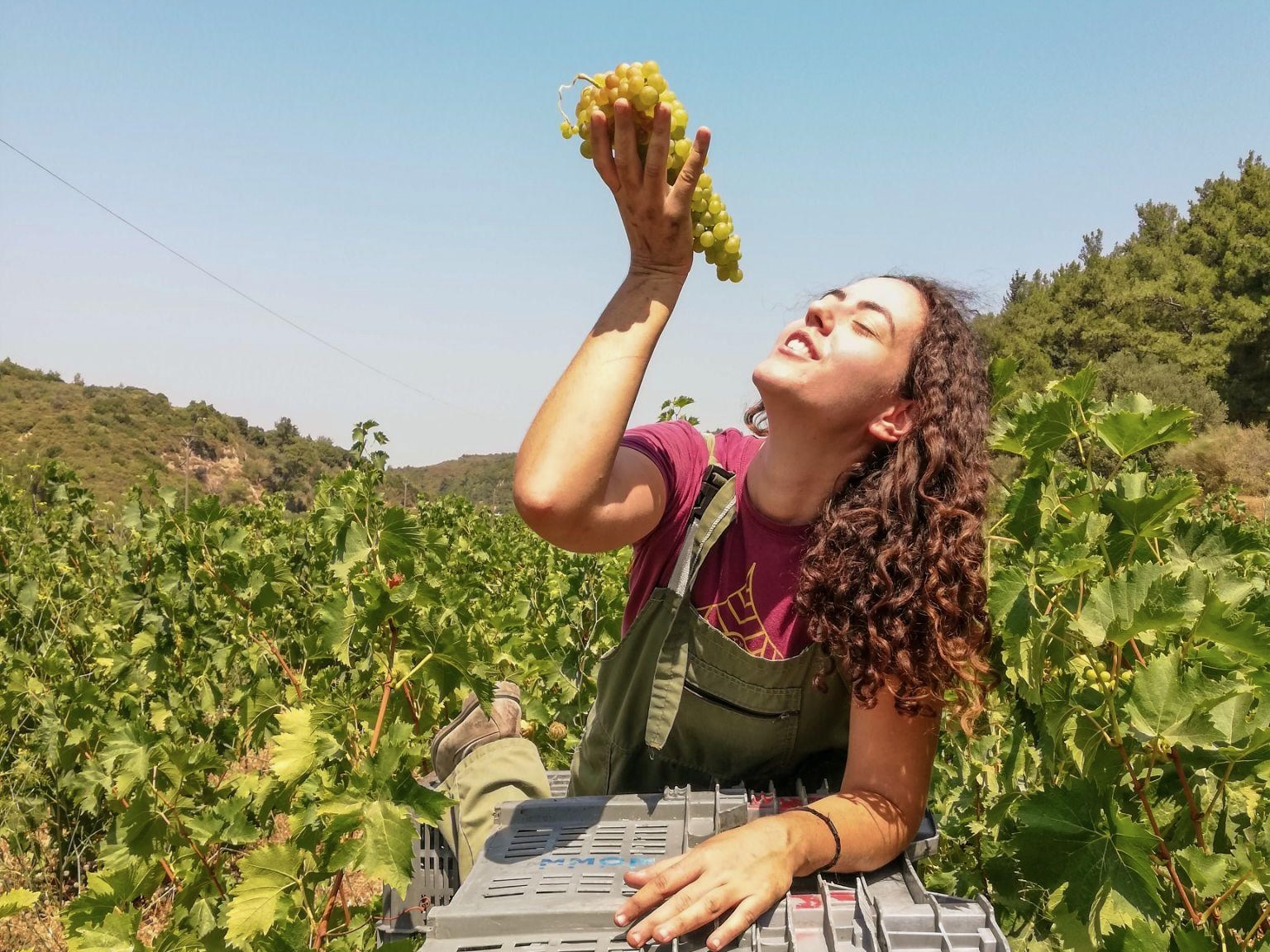
Harvest of Muscat at Samos island in the northern Aegean, Greece by Evmorfia Kostaki
我們或許品飲過無數動人的葡萄酒,參訪過不少地理環境特殊、設備新穎的酒莊,但很少人感受過,從無到有建立一個酒莊,需要經歷多少的磨難與挑戰!我們遠在希臘的夥伴 Evmorfia Kostaki,從雅典大學化學系女文青、加州大學戴維斯分校釀酒碩士,經歷葡萄酒大師學程的歷練,終於在Samos島嶼建立自己的酒莊。2015年的Samos島嶼,合作社是唯一合法的釀酒機構,她的家族先向歐洲人權組織申請設立私人酒莊的權利,慢慢選擇適當地塊、建立酒莊藍圖、購買釀酒設備,每一項都耗費大量時間與金錢,且短時間內無法預估投資報酬率!葡萄藤須經過數年才能產生達釀酒品質的果實,還得通過海島上多變氣候的挑戰!他們選擇遵循Samos傳統,種植小果蜜斯嘉葡萄 (Muscat Blanc à Petits Grains)單一品種,著重應用多變的釀酒技術和混調技巧,重新定義蜜斯嘉葡萄酒的當代風格。因為風格獨特不合法規,只能標示區域型葡萄酒 (PGI) 或是希臘國產葡萄酒( Wines of Greece)。正如現今眾所矚目的超級托斯卡尼,當年獨樹一格,由於不合法規,酒標只能是餐酒等級。不同於主流蜜斯嘉葡萄酒給人的香甜印象,Kostaki酒莊主要生產微甜,甚至不甜的酒款,鮮明的酸度帶出青蘋果、白桃的甜美感,和著些許海風與草本植物的氣息,據說是雅典市中心眾多中式餐廳酒單上的首選!若想走在時代前端,體驗超級托斯卡尼蛻變的歷史,不妨嘗試 Kostaki酒莊。
有些人認為葡萄酒只是對健康有害的酒精飲品,對 Evmorfia 來說,葡萄酒是和平、陪伴和夢想的產物。如果你只對投資感興趣,那麼葡萄酒大概不會是理想選項。倘若你願意傾其所有,甘冒數年內一無所獲的風險,只為能夠滿足味蕾與打動人心,那麼葡萄酒獨特的真善美將歷久彌新!


If you’re interested in exploring your limits, then wine production is for you. Resilience is the word that would describe the past five years of my life, where I went straight from student life to establishing and running a winery on my home island of Samos, in Greece. Early mornings and late nights, heatwaves and cold winter mornings made no difference. We were working all the time, and still it was not enough. Was it worth it? Let’s take a step back in 2020 to find out!
Back in spring 2020 the world stopped. I was in Samos, having just finished with my Master’s degree in Viticulture and Enology and the WSET Diploma. Feeling hopeless is not my strong point, I need to be in control of my life. So I used the planting rights my father applied for and planted a vineyard during the pandemic. And then, spring arrived and nature called for the nurturing of the older vines. By returning to Samos and working in my vineyards I realised this is where I wanted to build my life, yet being a grape grower and selling the grapes could not satisfy me.
Restless, I was looking out for spaces where I could start a winery. Like every other young person wanting to start a winery, I imagined the first harvest would be in a tiny garage, with old equipment that’s almost breaking down. But finding a suitable space and sourcing the equipment proved to be a challenge. As I was looking for other possibilities, I noticed a subsidy funding program opened up. I realised it was a once in a lifetime opportunity. Immediately, I went full force. Within two months, I had the building design ready and had selected the appropriate equipment. Turns out building a new winery and buying new equipment with the help of the subsidy cost me the same as the original plan!
What’s so interesting about Samos, is that until a few years before the cooperative was a monopoly, all grape growers were obligated to sell the grapes there. Private wineries were not allowed on the island. Growing up I remember my father battling this ridiculous system, and he was finally vindicated with a decision by the European Human Rights Court in 2015! Had he not fought for the right of Samos viticulturists to freely choose what to do with their grapes, the cooperative would still be a monopoly, and my story would have been entirely different.
After a long wait, our application was accepted and we started building in summer 2021, aiming to start operations with the harvest of 2022. However, due to the limited construction force of the island and a very harsh winter of 2022, the winery was not ready and we had to sell the grapes instead. It was a great setback to our morale, as we had to wait another full year. By now my partner Lorenz had permanently moved to Samos and we were taking care of my father’s vineyards together, which are all planted with Muscat Blanc à Petits Grains. We tried to see the bright side, and took this opportunity to restructure the vineyard, understand the land better, and be more decisive about the wines we wanted to create.
Muscat Blanc à Petits Grains is the variety synonymous with Samos Island viticulture. It may even originate from the island, although its roots are lost in history. It’s one of the oldest cultivated grape varieties, with references from the Ancient Greeks. They were the ones who spread it across the Mediterranean. This makes it the first international grape variety, since it was one of the main varieties that spread over to the new world as well. In Samos, almost all of the island’s vineyards are planted with Muscat Blanc à Petits Grains, and it’s the only variety permitted for the Samos PDO, which allows exclusively sweet wines. While the island has been producing dry wines they have never been a priority. We aimed to preserve this rich heritage of my island and elaborate my winemaking talents on crafting unique styles of wines from this noble, yet misinterpreted grape.
Muscat Blanc à Petits Grains is a very thin skinned variety with compact bunches. It is very sensitive to powdery mildew, the main fungal disease on the island. To decrease bunch compactness, we are doing leaf removal (only from north and east side) during flowering, to prevent perfect fruitset and have fewer berries per bunch. This way, the morning humidity is not trapped within the bunches, and also our spray has higher effectiveness. It is hard work, because the bush vines are very close to the ground, and it has to be done manually and in a timely manner. Another issue we have on the island is the European Grapevine Moth. It lays eggs on the grapes, and the caterpillars that hatch break the skins, leading to bunch rot. As the vineyards are organic, a precise spraying schedule with Bacillus thuringiensis is applied to control this issue.
With the 2023 vintage around the corner, we were completing the finishing touches of the operational arm of the winery. We welcomed this first vintage with celebration, focused on what we wanted to achieve, and with incredible fear at the same time. We took a big risk by choosing to not use any commercial yeast in the cellar, but luckily everything went well and our ferments started – and finished! At this point, three years have passed by since the first realisation that I wanted to be a winemaker on Samos. Three years where work was hard but the return on investment was zero.
That following winter felt endless. Everything we had, had been invested. One wrong move and my whole family is at a loss. The pressure was building, but fortunately the wines turned out according to plan. Working with one variety like we do, especially one as controversial as Muscat, was a big risk. Our goal was to prove it can produce amazing, textural and gastronomic wines, not just entry level fruit bombs. To achieve that we planned every last detail from harvest timing to winemaking techniques.
The identity of Kostaki winery is the focus on blending. Everything starts at harvest and we separate the different base wines in small vats. Some vats have direct pressed wine that’s harvested earlier, rich in acidity. Some vats have skin contact wine that’s more aromatic and smoother on the palate. Some others have skin fermented “amber” wine, which adds structure. We also use fermentation in large barrel (yes, it’s only one!) which can contribute roundness, as well as aromatic complexity. Being a Master of Wine student has truly helped me become a better blender. I have learned to focus on the details, “see” the wine with my mind, and imagine how I can best create my vision with the blending partners I have available. Lorenz is of course a great taster himself, and together we craft the blends of our wines with incredible precision. Luckily we have the same vision and blending is always a fun and exciting day!
Our bottling line arrived just a week before our first wine show, and we had to ship our labels directly to the wine fair because there was just no time for them to come to Samos before! Thankfully, the first presentation of the wines to the world had been a success. Our anxiety fell to normal (for a winemaker) levels and we finally sold our first bottles soon after! We worked hard, travelling with our little carry-on fridge to restaurants and wine shops first around Samos, then in neighboring islands, and finally in Athens, London and beyond. Slowly we started seeing an increasing appreciation of our wines. Four years of hard work pay off finally!
Only sweet wines made from Muscat can be labelled as Samos PDO. We take an audacious move to redefine the modern styles of Muscat wines, so none of our wines can have the name Samos on the label. Some wines are labelled as “Aegean Sea PGI”, but we also have wines that are simply “Wine of Greece”. For example, our Ancestral Method (Petnat) and Early Harvest (kabinett) are Wines of Greece, because their style is not included in the current PGI specifications.
Our flagship wine is “Kostaki Dry”, created using state-of-the-art winemaking techniques and sophisticated blending skills to achieve absolute balance. The base is direct pressed wine from one of the best terraces of our vineyard. We build on that with orange wine (to add structure and power), some barrel fermented wine (to add roundness to the mid-palate) and some skin contact wine (to adjust the aroma intensity). None of our wines are very aromatic. In our “Kostaki Dry” you enjoy a very elegant nose, with flavours of lemon, green apple, white peach, together with intense sea breeze character and herbs. On the palate it is light, but rounded, with a long, salty and slightly phenolic finish, making it a perfect gastronomic wine that supports the food without overwhelming it! In 2026 you can taste our wines in Millesime Bio (Montpelier, France), Oenorama (Athens, Greece), and the portfolio tasting of our UK importer Clark Foyster in London.
Making wine is a different kind of entrepreneurship. In any small business you have to do almost everything on your own, simply because there is not enough capacity to hire help. In the wine industry that doesn’t just mean working in the vineyards, making the wine and overseeing the finances. It also means resource planning, marketing, being a mechanic, creating the website and preparing the orders. And yet it is still not enough. We are currently in the process of building a tasting room. This means I get to also plan the visitor journey, and communicate with the visitors in addition to all the other jobs!
Many are keen to accuse wine of being just another form of poisoning alcohol. But it is so much more. It is a product of peace, of companionship and of dreams. Wine is not for you if you’re looking for a good investment. It’s for those willing to put their soul into their product, and go through five or more years without a single paycheck, just to create something tasty. It is a unique way of bringing beauty to this world.