
All sorts of rocks and soils in vineyards contain a wide range of minerals. Are they truly able to affect aromas and flavours in your glass? <Research Article Free Download>
你曾經感受過酒杯中的礦物味嗎?曾經用礦物感形容葡萄酒的風味嗎?礦物味到底是什麼呢?是從葡萄園的風土而來嗎?礦物味有科學根據嗎?抑或只是作家們善用的修辭?法國夏布利、德國雷司令、白蘇維濃乃至薄酒萊、內比奧羅等紅白酒款,真的和礦物味密不可分嗎?尤其布根地專家們最喜歡探討特殊礦物味與風土的關係。然而,大約七、八年前,許多葡萄酒專家、MW 葡萄酒大師,都建議少用礦物味來形容葡萄酒,因為缺乏科學根據,礦石本為固體,無法散發氣味分子,葡萄酒的氣味和口感反應葡萄園的風土環境是過分浪漫的想法。但是葡萄酒大量品飲的統計數字,往往顯示礦物感與鹹味、金屬感、濕石頭和硫化物的打火石、煙燻味高度相關,再者,富含礦物質的礦泉水口感上和純水也有明顯的分別。這些矛盾凸顯出,我們對於礦物味的起源和相關科學原理缺乏瞭解。
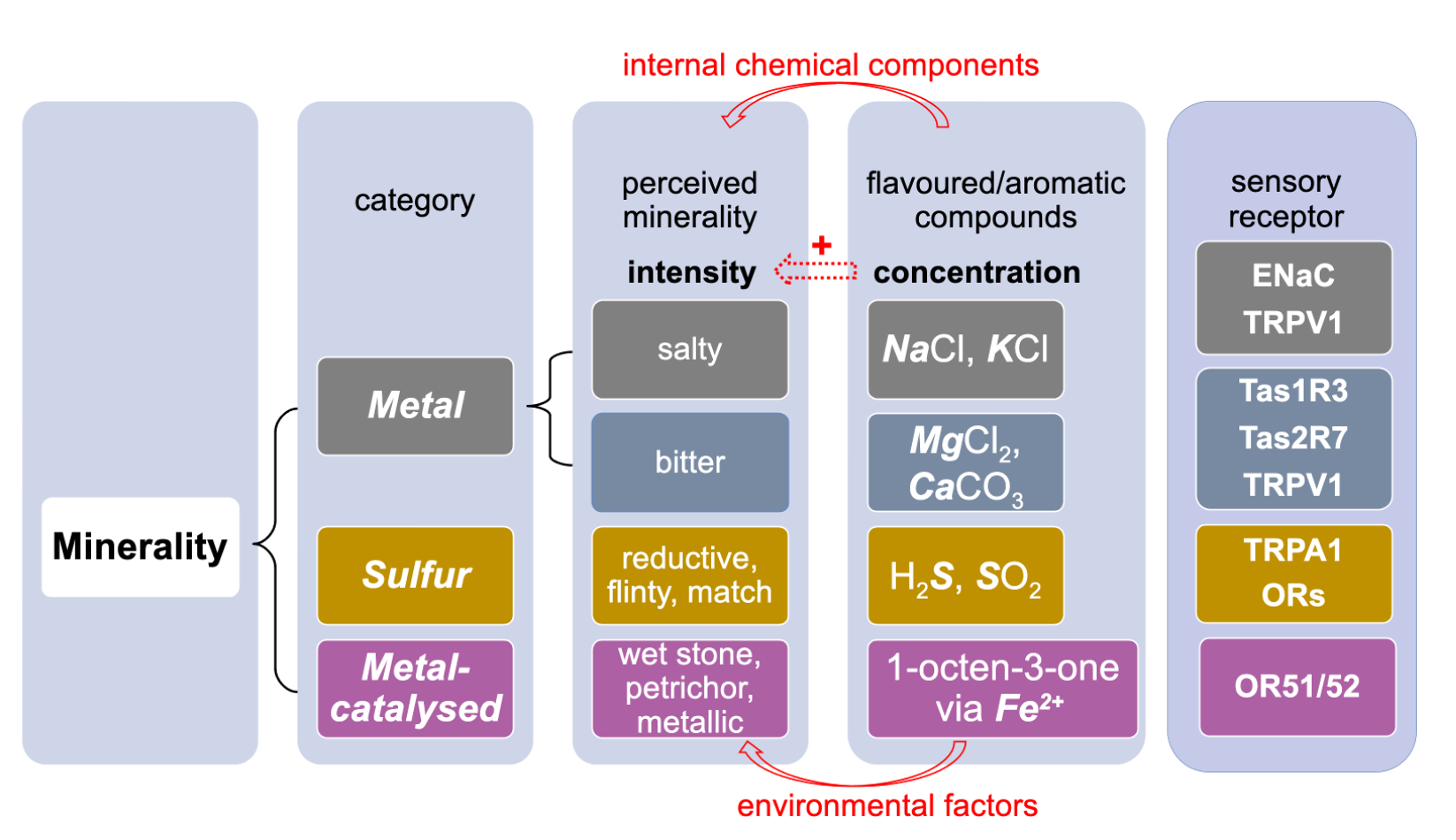
我們由礦物味的科學定義、來源與礦物味的類別,以及人體如何感知礦物味,來解析葡萄酒中的礦物味。簡單來說,礦物質是不含有碳原子並規則排列的無機化合物,由於不同的化學組成和反應途徑,葡萄酒中的礦物味主要可分為三類:1. 金屬 2. 金屬催化 3. 硫化物。金屬元素如含鈉、鉀的食用鹽,我們可直接感受鹹味或苦味,歸為金屬類,初雨、濕石頭等通常是鐵、銅等金屬,經由氧化還原反應產生的脂類有機衍生物所散發的氣味,因此歸為金屬催化類。至於煙硝味、煙燻感等常常是含有硫化物的緣故,故自成一類別。
人體對礦物味的嗅覺與味覺感知,主要由G蛋白偶聯受體(G protein-coupled receptors)和離子通道(ion channels)接收氣味分子產生,分別是2012年諾貝爾化學獎和2021年的諾貝爾生醫獎,重要性由此可知。通常一種感知受體可以感應多種氣味分子,一種化學分子也可被多種感知受體接收,整體訊號傳遞過程,牽涉多種蛋白質一連串的構型變化,現今仍是十分活躍的研究領域。科學解密酒杯中的礦物味,發表於重量級國際期刊 RSC Advances,人人皆可免費下載閱讀。
疑問一. 你曾經用過鹹味、濕石頭、汽油味、煙硝味來形容葡萄酒嗎?哪一種屬於礦物味呢?
科學家:汽油味主要源於特殊化學物質: 1, 6, -trimethyl-1,2-dihydronapthalene (TDN),目前生化機制不明,需要更進一步研究。然而鹹味、濕石頭和煙硝味,是礦物味無誤!
疑問二. 你曾經用過泥土味、火柴味、金屬味、初雨來形容葡萄酒嗎?哪一種屬於礦物味呢?
科學家:礦物是規則排列且不含碳或碳碳化學鍵的化合物,泥土味常源於微生物產生的有幾分子 2-methylisoborneol,目前我們並不全然了解此類生化機制。火柴味、金屬味、初雨皆為礦物味無誤!
疑問三. 葡萄酒呈現的礦物味是否來自風土呢?
科學家:科學研究已證實葡萄酒的組成與氣味分子和葡萄生長環境息息相關。因此,酒杯中的礦物味確實可以反應部分風土。然而,葡萄酒的礦物組成和土壤中的礦物質並沒有簡單易懂的正比關係,主要是因為葡萄藤對礦物質的吸收會受到土壤條件、水分與嫁接粘木種類等影響。再者,葡萄酒釀造過程也會改變最終產品的礦物組成。
Have you ever used minerality to describe the flavours or aromas in the glass? Have you ever tasted minerality in wines? What is minerality? Does mineral perception arise from vineyard rocks and soils? Is It a reality or a metaphor? Are Burgundy Chardonnay, German Riesling, and Sauvignon Blanc, as well as Gamay, Nebbiolo truly related to minerality? What is the current scientific understanding of mineral perception? We unravel the science of minerality in RSC Advances, a reputable international journal! Everyone can read and download the article for free.
Q1. Are descriptors such as salty, stony, petrol, flinty related to minerality?
Answer: Petrol aroma in white wines mainly arises from a chemical , 1, 6, -trimethyl-1,2-dihydronapthalene (TDN). The overall mechanisms of production remain unclear. Whether petrol is related to minerality needs further investigations. Salty, flinty, and stony are mineral, indeed!
Q2. Are descriptors such as earthy, match, metallic, petrichor related to minerality?
Answer: Minerals are inorganic (typically not containing carbon atoms or carbon-carbon bonds) compounds with an ordered atomic arrangement. Earthy odor often arises from 2-methylisoborneol, a molecule containing carbon mainly produced by microorganisms. The overall mechanisms of production remain unclear. Match, metallic, petrichor are mineral descriptors!
Q3. Is minerality related to terroir?
Answer: Scientific evidence has shown that chemical components in wines are related to terroir. Therefore, minerals in wines can certainly reflect parts of terroir. However, minerals in soils and wines do not have simple, linear correlations, because uptake of minerals from soils to vines is regulated by factors such as soil conditions, water availability, and rootstocks. In addition, winemaking can greatly affect minerals in wines.